Buying Into the Fear- March Newsletter
Operation Epic Fury changed everything for global markets over the last two weeks. Within hours of the strike on Iran’s leadership, the IRGC shut down the Strait of Hormuz, a 33 km passage between Iran & Oman that the world can’t afford to lose. Roughly 20% of global petroleum & 20% of global LNG transits through it daily. Oil from Saudi Arabia, UAE, Iraq, Kuwait, & Qatar all of it flows through this single corridor.
Brent crude, which was hovering around $67 in Feb, has now touched $105 per barrel. I had to update this figure four times while writing this letter. That alone tells you how fast things are moving.
Direct Impact on India
India imports roughly 88% of its crude oil. Here’s how our sourcing breaks down: Russia accounts for ~37% of imports, Persian Gulf nations (Iraq, Saudi Arabia, UAE, Kuwait, Iran) account for ~46%, and the remaining ~17% comes from the US, West Africa, and others. Nearly half of all our oil imports come from the Gulf, and almost all of it transits through Hormuz.
The math is straightforward: every $10/barrel increase in crude adds approx $14 billion to India’s annual import bill, pushes CPI up by ~0.2%, and widens our CAD by about 50 bps. At $105 Brent, that’s not a rounding error. It changes the macro picture. The Govt has indicated that India holds 6–8 weeks of fuel supply in strategic reserves (roughly 100 million barrels). That’s a buffer, not a solution. Reserves are designed for short-term emergencies, not a prolonged supply disruption. OMCs are currently absorbing the hit through their marketing margins (~Rs. 10/litre on petrol, ~Rs. 4 on diesel). If crude stays elevated beyond 4 to 6 weeks, those margins get squeezed to zero, and that’s when we will likely see retail price hikes at the pump.
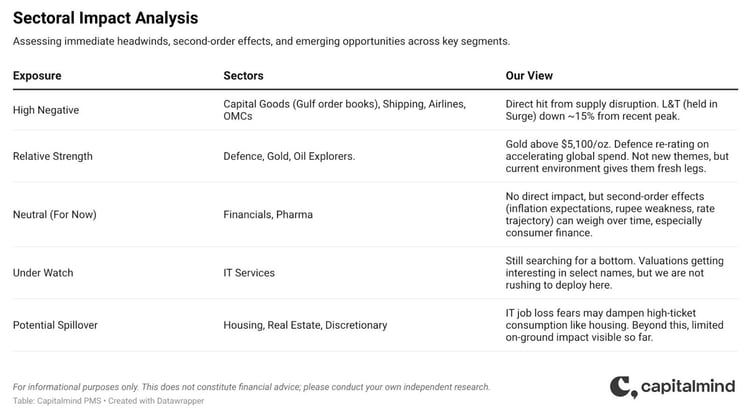
Coming to the portfolios:
Surge India is up 0.13% in Feb versus -0.51% for Nifty 50 TRI.
- Auto & Ancillaries: This remains our highest-conviction allocation. We are in the sixth month of GST 2.0 implementation, and the on-ground impact has been tangible. Dealer inventory cycles are tightening & the demand is strong (Ashok Leyland Feb sales up 25% YoY, M&M Auto 15% YoY, Maruti 9.6%, Tata Motors CV 31% YoY, TVS at 26% YoY). The 2W, passenger vehicle, and commercial vehicle cycles continue to track well. Auto ancillaries like Belrise Industries (one of our stronger performers this year) and SJS Enterprises (a small-cap, debt-free business that keeps delivering quietly) complement this theme. The broader auto story of premiumisation, replacement cycles, and rural recovery remains intact.
- PSU Banks: SBI and Indian Bank are names we have held in this pack. The fundamental picture hasn’t changed: credit growth remains strong at 14.5% YoY, asset quality has improved structurally, and valuations are still reasonable relative to private-sector peers.
- Private Financials: Shriram Finance, Bajaj Finance, ICICI Bank, and Ujjivan SFB form a core part of the portfolio. We are comfortable holding these through the current volatility.
- Our cash deployment stance: After the correction, we have started deploying our cash position at 9%. But I want to be specific about why, because “be greedy when others are fearful” without reasoning behind it is just a slogan. Here’s what we are seeing: markets have historically discounted geopolitical events within 4–6 weeks (post-Gulf War 1991, post-9/11, post-Russia/Ukraine in 2022). In each case, the initial spike in crude and the corresponding equity sell-off created a window where fundamentally sound businesses traded at a meaningful discount to intrinsic value. We believe we are in that window now. The risk we are watching is duration. If Hormuz stays closed beyond 8–10 weeks, the playbook changes, and we will re-evaluate. We are not deploying aggressively. We are adding to high-conviction names where valuations have become attractive while maintaining enough cash to act further if the correction deepens.
Adaptive Momentum
Adaptive Momentum is up 1.51% in Feb versus -0.51% for Nifty 50 TRI. A decent month, but one month doesn't change the broader picture.
- The strategy has been through a difficult stretch. 2024 and 2025 were cyclical downturns for momentum as a factor, and investors who joined over the last 2–3 years are going through a rough patch.
- Statistically, we are in what is roughly a 10th percentile outcome on a 3-year holding basis. It doesn’t happen often. But when it does, it tests patience. We expect momentum as a factor to revive, but we cannot tell with certainty when the tide will turn.
- What we have changed: The core model, systematic stock selection and portfolio construction remain unchanged. What we have layered in is a discretionary overlay to address the edges that the model misses in volatile regimes, like acting on early growth signals before full model confirmation, tightening risk through dynamic position sizing, liquidity filters & sector rotation. Early results are encouraging better entries, tighter drawdowns in select pockets. But I want to measure this over 2–3 quarters before making any definitive claims.
Mutual Fund Strategies
- All Weather Equity & SmartCore: Both strategies continue to perform well and are comfortably ahead of their benchmark since inception. By design, they adapt well to volatile markets, they invest across the best-performing mutual fund categories (flexi-cap, mid & small-cap, focused) and provide necessary balance on the overall portfolio. All Weather’s recent review confirmed all constituent funds continue to meet our selection criteria. SmartCore had one rebalance in the midcap category (HSBC Midcap replaced with Edelweiss Midcap). If you are looking to deploy cash but prefer not to take direct equity exposure, these are well-suited strategies for that.
- New Strategy (Launching Soon): We are launching a new mutual fund strategy designed to deliver stable returns in a tax-efficient manner, with lower risk and volatility compared to a pure equity approach. Like our other mutual fund strategies, this is rule-based, combining our in-house quantitative shortlisting model with a layer of informed discretion. You will be receiving the detailed investment approach document from our team shortly.
Where We Stand
Right now, we are in Rahul Dravid mode. Sticking to the crease, playing tight, waiting for the loose ball, and we are already getting a few. The noise will continue. Our job is to stay focused on what we can control: earnings growth, valuations, and deploying at the right price. We are doing exactly that.
With patience at the crease,
Krishna Appala
Disclaimer: Investing in securities markets involves risk, and no specific returns or performance are guaranteed. This communication is issued by Capitalmind Financial Services Private Limited for informational purposes only and does not constitute investment advice, a research report, or an offer/solicitation to buy or sell any securities or portfolio management services. It is not directed at residents of the United States of America, UAE, Singapore, or any jurisdiction where access without proper registration is restricted. While the information is believed to be reliable, Capitalmind and its affiliates doesn't guarantee its accuracy or completeness, and shall not be liable for any loss arising from reliance on this material. Performance data, where mentioned, is based on past results, shown net of fees unless stated otherwise, annualized for periods exceeding one year, is not verified by SEBI, and should not be considered indicative of future performance. Any back-tested performance is simulated and does not represent actual client returns, which may vary due to timing of contributions, market conditions, and other factors. Please exercise independent judgment and seek professional advice before investing. This material is confidential and may not be reproduced or redistributed without prior written consent. For further details, please refer to our Disclosure Document at https://www.capitalmind.in/disclosure#disc-pms.